What This Comparison Covers
Ethereum is the most widely deployed smart contract platform in the world. It has a developer ecosystem that QuanChain does not yet match, 10+ years of battle-tested tooling, and a validator set and liquidity depth that take years to build. Any honest comparison has to acknowledge these facts.
This comparison focuses on security architecture, specifically the technical dimensions that determine how well each chain handles the transition to a post-quantum threat environment. The goal is not to declare a winner but to give developers, validators, and researchers a clear view of the tradeoffs before they decide which infrastructure to build on.
Signature Scheme: ML-DSA-87 vs ECDSA
Ethereum uses ECDSA (secp256k1) for transaction signatures and BLS12-381 for validator signatures. Both are elliptic curve schemes. Neither provides quantum security. A quantum computer running Shor's algorithm can recover private keys from either scheme once hardware capabilities reach the relevant threshold. Ethereum's roadmap (the "Endgame" phase) plans to address this, but no mainnet timeline is committed as of mid-2026.
QuanChain uses ML-DSA-87 for all transaction and validator signatures. ML-DSA-87 (formerly CRYSTALS-Dilithium at security level 5) is one of the algorithms standardized by NIST in 2024 specifically for post-quantum security. It produces 4,595-byte signatures and provides 256-bit quantum security, meaning a quantum adversary needs to perform roughly 2256 operations to forge a signature. ECDSA signatures are 64-72 bytes and provide 0 bits of quantum security against Shor's algorithm.
The larger ML-DSA-87 signature size has throughput and storage implications, which the sections below address. But the quantum security gap between the two schemes is categorical, not a matter of degree. Read more about how signature size affects blockchain throughput and how QuanChain manages it.
On-Chain Key Exposure: Never vs Always After First Transaction
On Ethereum, your public key is revealed the first time you send a transaction from an address. It is recorded permanently in the transaction input. Every address with any outgoing transaction history has its public key on-chain. At current counts, the vast majority of externally owned Ethereum accounts have exposed public keys.
On QuanChain, no public key is ever permanently recorded on-chain. SpendAndRotate rotates to a new child key in every spend transaction. What appears on-chain is a commitment (hash) to the current key, not the key itself. The public key appears only during the transaction finality window (sub-second on Channel 1) and is immediately retired after the rotation completes.
This difference matters most when a quantum adversary "harvests" public keys from historical blockchain data to attack later. Ethereum's historical record is a complete database of exposed keys. QuanChain's record contains no useful key material for this attack.
Post-Quantum Migration Path
Ethereum's post-quantum migration requires changes to the account model, the transaction format, the EVM opcode set, and the consensus layer. The most realistic approach involves account abstraction (EIP-7702 or similar) to allow accounts to use alternative signature verification logic, plus a hard fork to add native post-quantum opcodes. The Ethereum Foundation's research team has proposed this path, but coordinating a migration across 1M+ validators and tens of thousands of deployed contracts takes years under the best conditions.
QuanChain's migration path is handled by CCRP (Cryptographic Currency Rotation Protocol). CCRP is protocol-native: the transaction format already includes a version field, the network already accepts multiple algorithm versions simultaneously, and the three-phase migration process (parallel acceptance, deprecation, cutover) executes without a hard fork. The Quantum Threat Oracle triggers CCRP automatically when LQCp/h crosses defined thresholds.
The practical difference: Ethereum's migration requires coordinated human action across a large, decentralized ecosystem. QuanChain's migration is automated and protocol-enforced. Both can migrate, but the confidence in timing and completion is structurally different.
Throughput: Three-Channel Architecture vs EVM
Ethereum L1 processes approximately 15-30 transactions per second. Layer 2 solutions (Arbitrum, Optimism, Base) increase this significantly, but L1 throughput remains the bottleneck for settlement. The EVM's sequential execution model and the gas limit per block cap overall throughput. Post-quantum signature schemes would increase this pressure: an ML-DSA-87 signature is 63x larger than an ECDSA signature, which means more bytes per transaction, lower transactions per block, and higher fees for the same transaction.
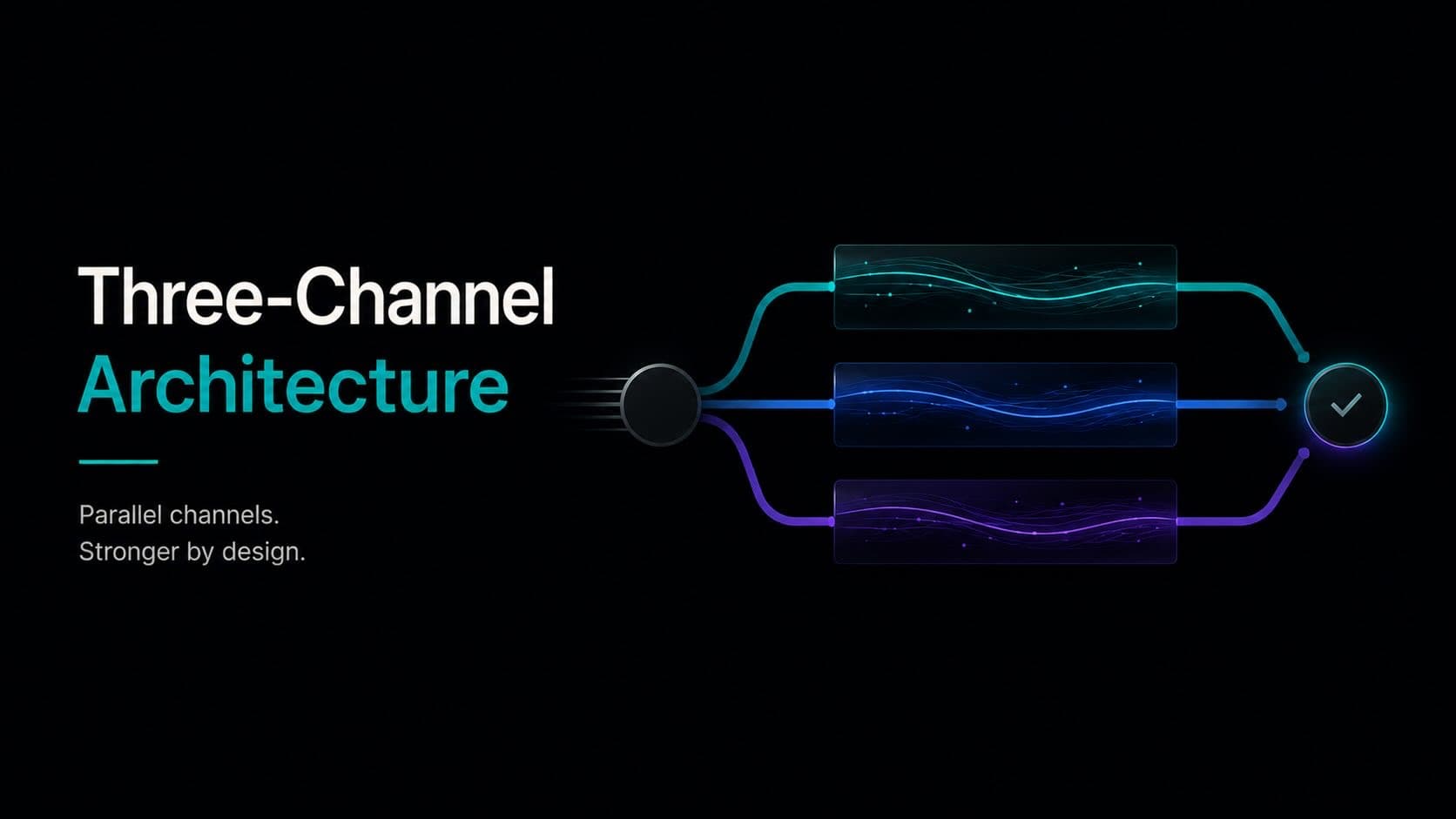
QuanChain's three-channel architecture addresses this by separating transaction types. Channel 1 handles payments at 200,000 TPS. Channel 2 handles smart contracts at 15,000 TPS. Channel 3 handles oracle and data feeds. Each channel optimizes for its workload independently. Payment transactions do not compete with smart contract execution for block space.
TADEQS compression also reduces the on-chain storage cost of ML-DSA-87 signatures by 70% compared to storing them raw, which is the primary driver of QuanChain's 70% data efficiency advantage over comparable chains. The Channel 2 smart contract throughput of 15,000 TPS compares directly to Ethereum L1's 15-30 TPS: a roughly 500-1000x difference for the smart contract use case.
Consensus: Proof of Coherence vs Proof of Stake
Ethereum uses Proof of Stake with a validator minimum of 32 ETH. Validator selection for block proposals uses a weighted random function based on effective stake. A validator with 2x the stake has 2x the probability of being selected. Large staking pools (Lido, Rocket Pool) hold a significant fraction of total staked ETH, raising centralization concerns that the community actively debates.
QuanChain uses Proof of Coherence, where validator weight is 50% stake and 50% performance metrics (uptime, latency, signature accuracy). A validator cannot dominate block production through stake alone: they must also maintain high performance. This creates a structural resistance to purely capital-driven centralization. The minimum stake is 50,000 QCH, and delegation allows smaller holders to participate without running full nodes.
State Bloat From Larger Signatures
ML-DSA-87's 4,595-byte signatures are large relative to ECDSA. On a chain that stores raw signatures, this would inflate state size significantly. Ethereum's state grows at roughly 50-100 GB per year under current conditions; a switch to ML-DSA-87-scale signatures without compression would accelerate this by an order of magnitude.
TADEQS handles this through signature compression and a proof aggregation scheme applied at the block level. Individual transactions carry full ML-DSA-87 signatures for verification purposes, but the stored block data uses aggregated proofs that reduce per-signature on-chain storage. The 70% data efficiency reduction vs comparable chains is the net result of this compression. Ethereum's state management does not include an equivalent mechanism today, which is one reason post-quantum adoption on Ethereum requires protocol-level changes rather than a parameter update.
Current Quantum Readiness
QuanChain's testnet launched in 2025 with all post-quantum features live: ML-DSA-87 signatures, SpendAndRotate, CCRP, and the Quantum Threat Oracle. The mainnet architecture is quantum-resistant today, not as a future upgrade.
Ethereum's quantum readiness is planned for its "Endgame" roadmap phase. The research is active and serious, but the mainnet deployment date is not committed. The Ethereum Foundation's post-quantum working group has published proposals but no EIPs with scheduled activation block heights as of mid-2026.
This is not a criticism of Ethereum's engineering. Retrofitting post-quantum security onto a live chain with trillions in assets and a decade of deployed contracts is a genuine hard problem. QuanChain's advantage here comes from being designed post-quantum from genesis, not from superior engineering talent. The comparison is architectural, not evaluative.
QuanChain vs Ethereum: Technical Comparison Table
The table below summarizes the key dimensions at a glance.
| Dimension | QuanChain | Ethereum |
|---|---|---|
| Signature scheme | ML-DSA-87 (256-bit quantum security) | ECDSA / BLS (0-bit quantum security) |
| Public key on-chain | Never (commitment only) | Yes, after first outgoing transaction |
| Post-quantum migration | CCRP (protocol-native, automated) | Requires hard fork + account abstraction |
| Smart contract TPS | 15,000 (Channel 2) | ~15-30 (L1) |
| Payment TPS | 200,000 (Channel 1) | ~15-30 (L1) |
| Consensus | Proof of Coherence (50% stake + 50% performance) | Proof of Stake (stake-weighted) |
| Signature storage | 70% reduction via TADEQS compression | Raw state, growing ~50-100 GB/year |
| Quantum readiness | Live on testnet (2025) | Planned (Endgame phase, no committed date) |
Ethereum's genuine strengths include its developer ecosystem (the largest in blockchain), 10+ years of EVM tooling and auditing experience, deep liquidity across DeFi protocols, and a validator set that has operated without catastrophic failure through multiple market cycles. For applications where those strengths matter most and quantum risk is not the primary design constraint, Ethereum is a rational choice today.
For applications where the post-quantum security of both transaction signing and smart contract execution is a first-order requirement, QuanChain's architecture is the only production option available now. The difference is not theoretical. QuanChain's testnet is running today, and all the mechanisms described in this article are active.