The TPS Problem in Blockchain
Throughput has been blockchain's most visible limitation since Satoshi's original Bitcoin implementation processed roughly 7 transactions per second. Ethereum launched with a similar ceiling. Visa processes roughly 1,700 transactions per second on average with burst capacity above 24,000. Global financial infrastructure, taken in aggregate, operates at scales that make even modern "high performance" L1s look like dial-up.
The conventional response has been vertical scaling: faster hardware, more parallelism within a single execution environment, or moving computation off-chain to rollups while using the base layer as a settlement and data availability layer. These approaches work, but they each introduce tradeoffs — increased centralization risk from hardware requirements, reduced composability from sharding, or reduced security guarantees from optimistic or ZK rollup bridges.
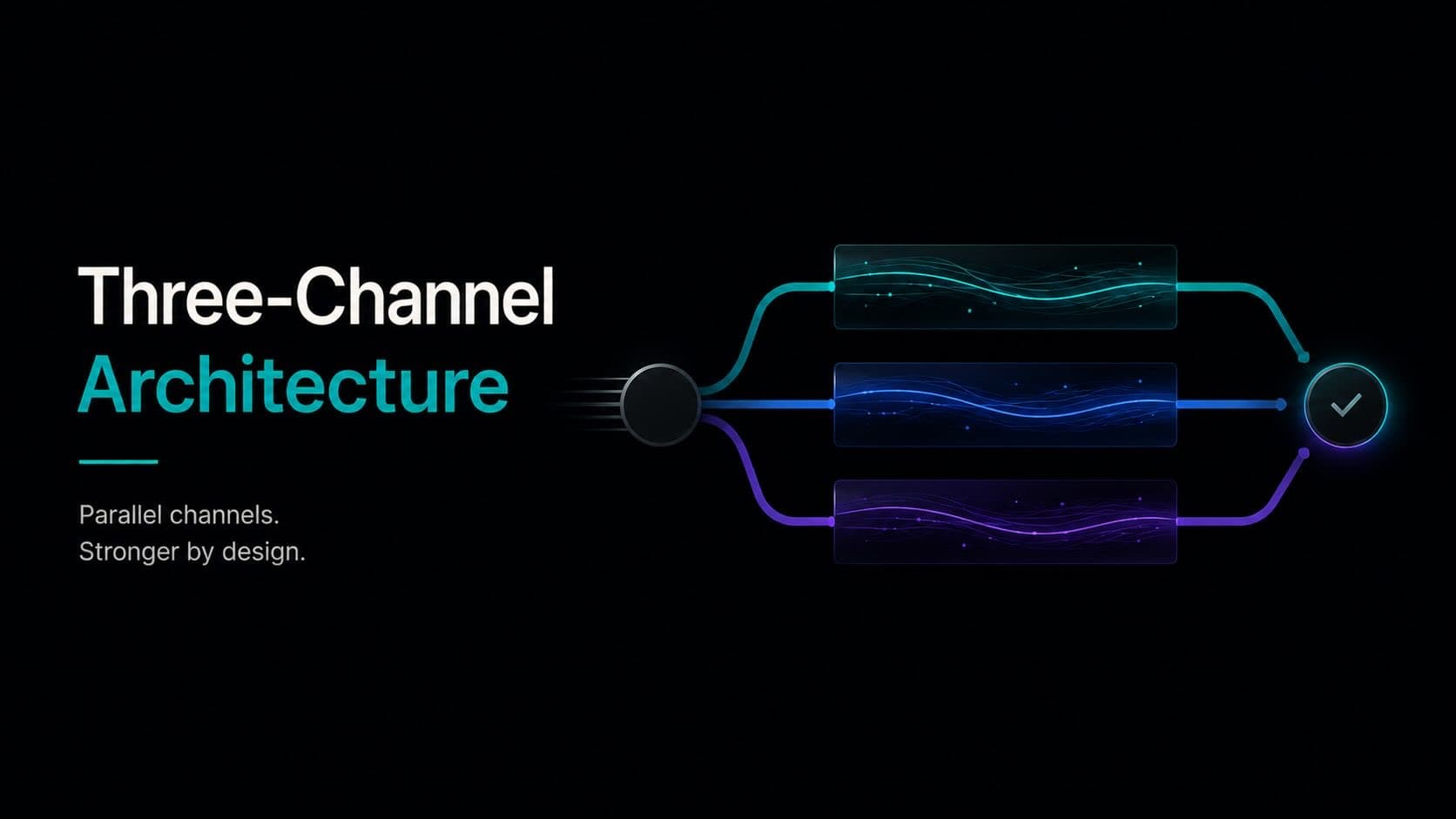
QuanChain's approach is different: rather than trying to make one execution environment faster, it separates transaction types into three purpose-built channels and optimizes each for its specific workload. This is the Three-Channel Architecture, and it is why QuanChain achieves 200,000+ TPS on a high-throughput blockchain without sacrificing security or composability.
Why Parallelism Works (And Where It Breaks)
Most blockchain throughput bottlenecks come from sequential processing requirements. If every transaction could potentially touch any piece of shared state, you cannot safely process them in parallel — you need to order them, execute them in sequence, and check for conflicts. This is why the Ethereum Virtual Machine, despite years of optimization, remains fundamentally sequential in its execution model.
Parallelism becomes safe when you can guarantee that two transactions do not conflict — that they access different state and have no dependencies on each other. The key insight behind QuanChain's architecture is that the vast majority of transactions fall cleanly into one of three categories, each with distinct state access patterns:
- Payments: Transfer of value between accounts. State access is limited to sender and receiver balances. Conflicts are rare and easily detected.
- Smart contract execution: Interactions with deployed contracts. State access is broader and less predictable, but contracts can be analyzed statically for dependencies.
- Data operations: Anchoring, attestation, and retrieval of on-chain data. State access is append-mostly, with limited conflict surface.
By routing each category to a dedicated channel with a purpose-built execution environment, QuanChain enables aggressive parallelism within each channel without the complexity of cross-channel conflict resolution for the 95%+ of transactions that stay within a single channel.
Channel 1: Payments at 200,000+ TPS
Channel 1 is QuanChain's payment layer. Its design goal is maximum throughput for simple value transfers — the kind of transaction that makes up the overwhelming majority of global financial activity by volume.
Channel 1 achieves 200,000+ TPS through several mechanisms:
- UTXO-style parallel validation: Transactions that spend different outputs have no conflicts and can be validated in parallel across all available CPU cores. Channel 1 uses a modified UTXO model adapted for TADEQS wallets.
- Signature batching: Multiple Dilithium-5/SPHINCS+-256f signature verifications are batched and verified together, amortizing the overhead of post-quantum signatures across many transactions.
- Commitment compression: TADEQS key commitments use a compressed encoding that reduces the per-transaction byte footprint by approximately 70% compared to naive implementation of composite PQC signatures. This is the "data compression adds 70% efficiency" figure — it applies specifically to the commitment layer within Channel 1, where signature data is the dominant cost.
- Dedicated mempool: Channel 1 maintains its own mempool separate from Channels 2 and 3. High-value smart contract activity on Channel 2 cannot crowd out payment transactions on Channel 1, and vice versa.
Channel 2: Smart Contracts at 15,000+ TPS
Channel 2 is QuanChain's smart contract layer, offering 15,000+ TPS for contract interactions. This is where DeFi protocols, NFT platforms, DAOs, and other programmable applications live.
The throughput target for Channel 2 is lower than Channel 1 for a straightforward reason: smart contract execution is inherently more complex. Contracts can read and write arbitrary state, call other contracts, emit events, and consume varying amounts of computational resources. Parallel execution requires careful dependency analysis to ensure correctness.
Channel 2 handles this through:
- Static dependency analysis: Before execution, the runtime analyzes which storage slots each transaction will access. Transactions with disjoint access sets are executed in parallel; those with overlapping sets are sequenced.
- Optimistic parallel execution with rollback: Transactions are speculatively executed in parallel. If a conflict is detected post-execution, conflicting transactions are rolled back and re-executed sequentially. Empirically, conflict rates are low enough that optimistic parallelism provides substantial net throughput gains.
- Gas metering calibrated for PQC overhead: The gas model on Channel 2 accounts for the computational cost of post-quantum signature verification in cross-contract calls, preventing adversarial gas exhaustion attacks that exploit PQC overhead.
Channel 3: Data at 2,000+ TPS
Channel 3 is QuanChain's data layer, processing 2,000+ TPS for data anchoring, attestation, and retrieval operations. This channel serves use cases that need the immutability and auditability of blockchain without the latency sensitivity of payment flows or the computational weight of smart contract execution.
Typical Channel 3 use cases include:
- Supply chain provenance records
- Identity and credential attestations
- Cross-chain state roots anchored via the CCRP protocol
- Regulatory reporting and audit trails
- IoT sensor data anchoring
Channel 3 operations are append-mostly, which enables aggressive write parallelism. Reads are served from a dedicated index that is updated asynchronously, preventing read-heavy workloads from competing with write throughput.
How Channels Interact: Cross-Channel Transactions
Some operations span channels — a DeFi protocol on Channel 2 might need to trigger a payment on Channel 1 and anchor a settlement record on Channel 3 as part of the same logical operation. QuanChain handles this through atomic cross-channel transactions: multi-step operations that either fully complete across all relevant channels or fully roll back.
Cross-channel coordination adds latency relative to single-channel operations — typically one to three additional block times depending on the channels involved. This is an intentional tradeoff: cross-channel atomicity is slower than single-channel operations, which incentivizes developers to architect applications that minimize cross-channel dependencies, keeping the common path fast.
Comparison to Monolithic Chains
A monolithic chain processes all transaction types through a single execution environment. The throughput ceiling is set by the slowest transaction type that the environment must support — typically complex smart contract execution. Even if 90% of transactions are simple payments that could be processed much faster, they all wait in the same queue as the complex ones.
QuanChain's separation means that a surge in DeFi activity on Channel 2 does not slow payments on Channel 1. A data anchoring burst on Channel 3 does not crowd out smart contract gas auctions on Channel 2. Each channel is optimized for its workload and isolated from the others at the throughput level.
The result is a network that behaves like a high-throughput blockchain under real-world conditions — not just synthetic benchmarks — because its architecture reflects the actual distribution of transaction types in production.
The Three-Channel Architecture is live on the QuanChain testnet. Developers can submit transactions across all three channels, observe per-channel throughput metrics in real time, and test cross-channel atomic operations at quanchain.ai.