A New Kind of Blockchain for a New Kind of Threat
The blockchain industry has spent fifteen years optimizing for speed, cost, and decentralization. Almost none of that effort has addressed the one threat capable of invalidating every cryptographic assumption those networks are built on: quantum computing.
QuanChain was created to solve that problem — not with a patch or a migration plan, but with an architecture that treats quantum resistance as a first-class design constraint from block zero. It is the world's first quantum-resistant blockchain that dynamically adapts its cryptographic posture based on real-time signals from the quantum computing landscape.
Why "Dynamic" Matters
Most post-quantum proposals treat the quantum threat as a fixed target: pick a hard algorithm, implement it, done. But quantum capability is not static. The number of logical qubits available to adversaries changes month to month, and the cost of running a cryptographically relevant attack is falling on a measurable curve.
QuanChain's Quantum Oracle continuously monitors LQCp/h — Logical Qubit Cost per Hour — and feeds that signal into a dual-path cost model that evaluates the real-world feasibility of both Grover-class attacks (against hash functions) and Shor-class attacks (against elliptic-curve signatures). When the Oracle detects that attack costs are crossing predefined thresholds, the network triggers a migration to stronger cryptographic parameters automatically, without requiring user action or a hard fork.
This is not a theoretical feature. The three-tier migration trigger system is live on testnet today.
The Core Systems
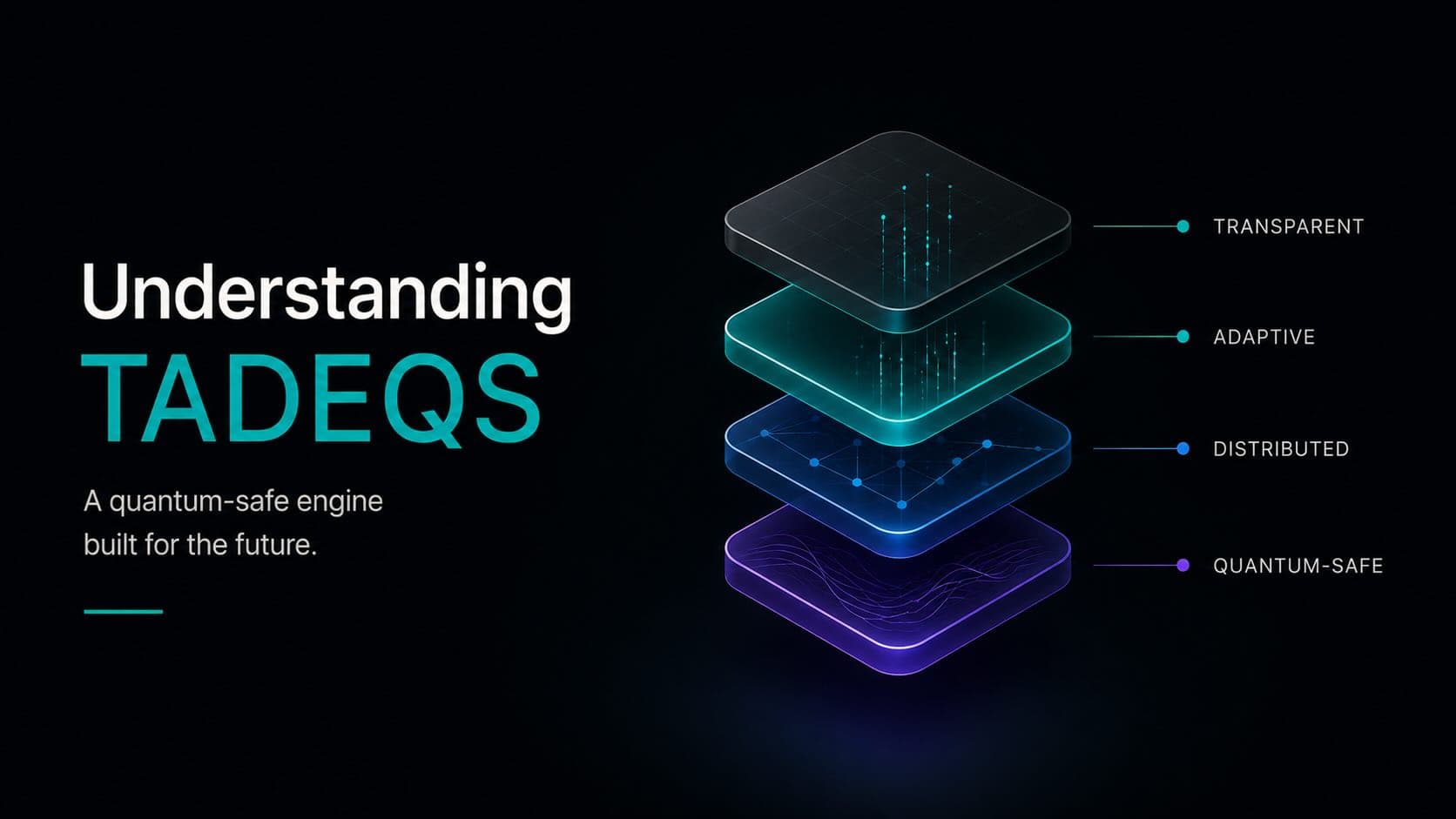
TADEQS: Threat-Adaptive Dynamic Encryption and Quantum Security
Every wallet on QuanChain is protected by TADEQS, a parent/child key architecture that ensures no public key is ever exposed on-chain. Traditional blockchains expose your public key the moment you make a transaction — handing quantum adversaries exactly the data they need to run Shor's algorithm against your account. TADEQS eliminates that surface entirely through SpendAndRotate atomic key rotation: every time you spend, your key material rotates in the same atomic operation, leaving nothing behind for an attacker to harvest.
Three-Channel Architecture
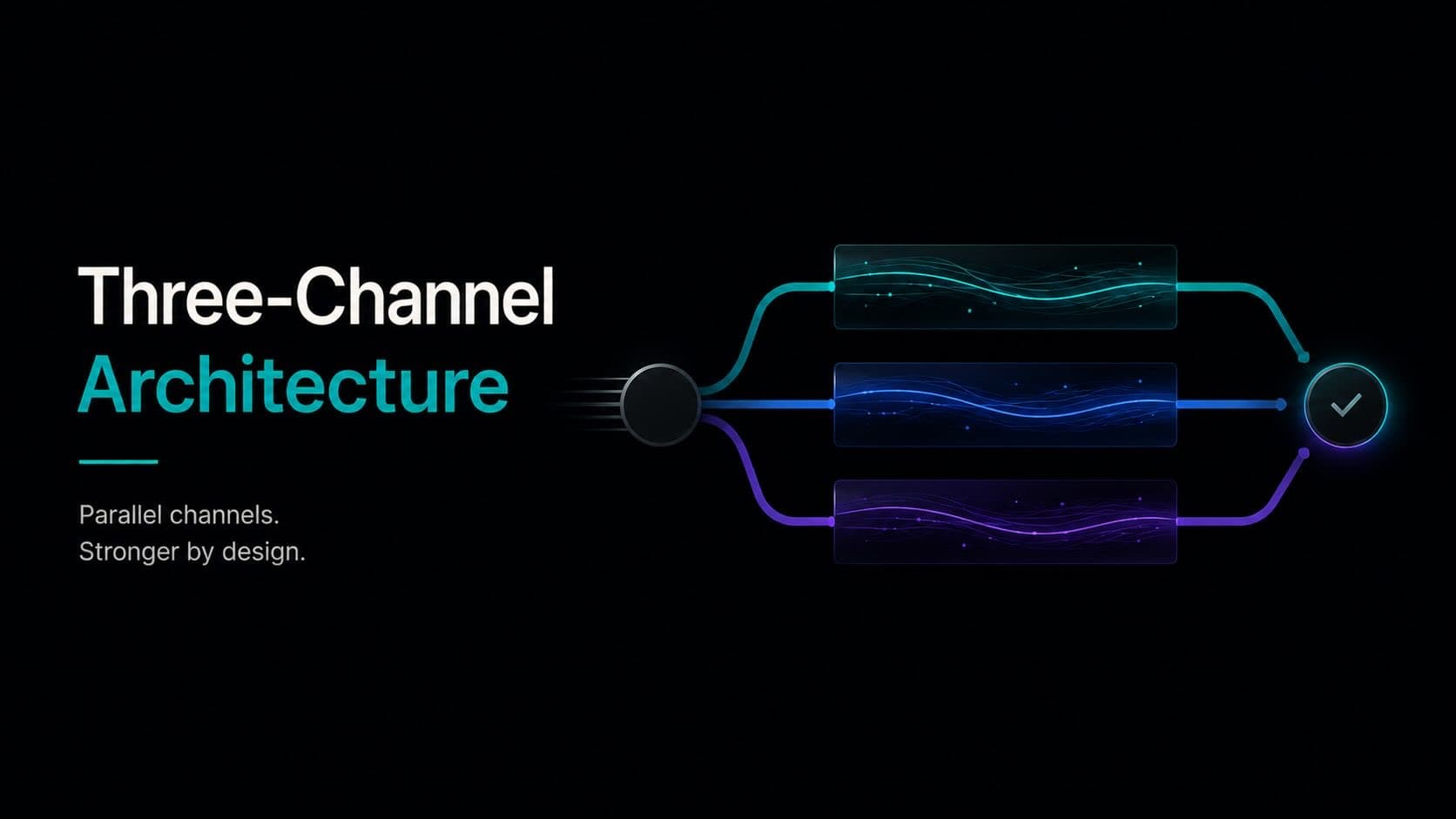
QuanChain separates transaction workloads across three purpose-built channels:
- Channel 1 handles payments at 200,000+ transactions per second
- Channel 2 handles smart contract execution at 15,000+ TPS
- Channel 3 handles data anchoring at 2,000+ TPS
By refusing to route all traffic through a single execution environment, QuanChain avoids the head-of-line blocking that throttles monolithic chains during peak demand.
Proof of Coherence
QuanChain's consensus mechanism allocates validator influence equally between stake weight (50%) and performance metrics (50%). This logarithmic scaling model prevents whale dominance without sacrificing the economic security that staking provides. Validators who operate quantum-hardened infrastructure receive additional bonuses, creating a direct financial incentive for the network to remain ahead of the threat curve.
CCRP: Cross-Chain Referential Points
The Cross-Chain Referential Points protocol anchors QuanChain's state to Bitcoin, Ethereum, and Solana at regular intervals. This means the security of QuanChain's history benefits from the combined proof-of-work and proof-of-stake weight of three of the largest networks in existence — a kind of cryptographic belt-and-suspenders for finality.
Who QuanChain Is Built For
QuanChain is relevant to three groups in particular:
- Developers building financial infrastructure that needs to remain secure for ten or more years. If your contract or application will still be running when fault-tolerant quantum computers arrive, the cryptography underneath it matters now.
- Institutions subject to regulatory requirements around data integrity and long-term auditability. The "harvest now, decrypt later" attack vector — where adversaries collect encrypted blockchain data today and decrypt it once quantum hardware matures — is a documented threat that regulators are beginning to address.
- Validators and node operators who want exposure to a next-generation network before it reaches mainnet scale.
Testnet Is Live
QuanChain's testnet is live at quanchain.ai. Developers can deploy smart contracts on Channel 2, test payment flows on Channel 1, and interact with the TADEQS wallet system using test QCH from the public faucet. The Quantum Oracle is active on testnet, and the three-tier migration trigger system can be observed in real time.
The question is not whether quantum computers will threaten blockchain security. The question is whether your blockchain will be ready when they do. QuanChain's answer is: it already is.
What's Next for QuanChain
Over the coming weeks, we'll be publishing deep dives into each of QuanChain's core systems: TADEQS, the Three-Channel Architecture, Proof of Coherence, and the Quantum Oracle. If you're building on the frontier of blockchain infrastructure, follow along — and come test on the network at quanchain.ai.