Why the Architecture Race Matters for Blockchain Security
For the past several years, discussions of quantum threats to blockchain security centered on a single question: when will quantum computers reach cryptographically relevant scale? That question assumed a specific answer depended on one dominant hardware approach succeeding.
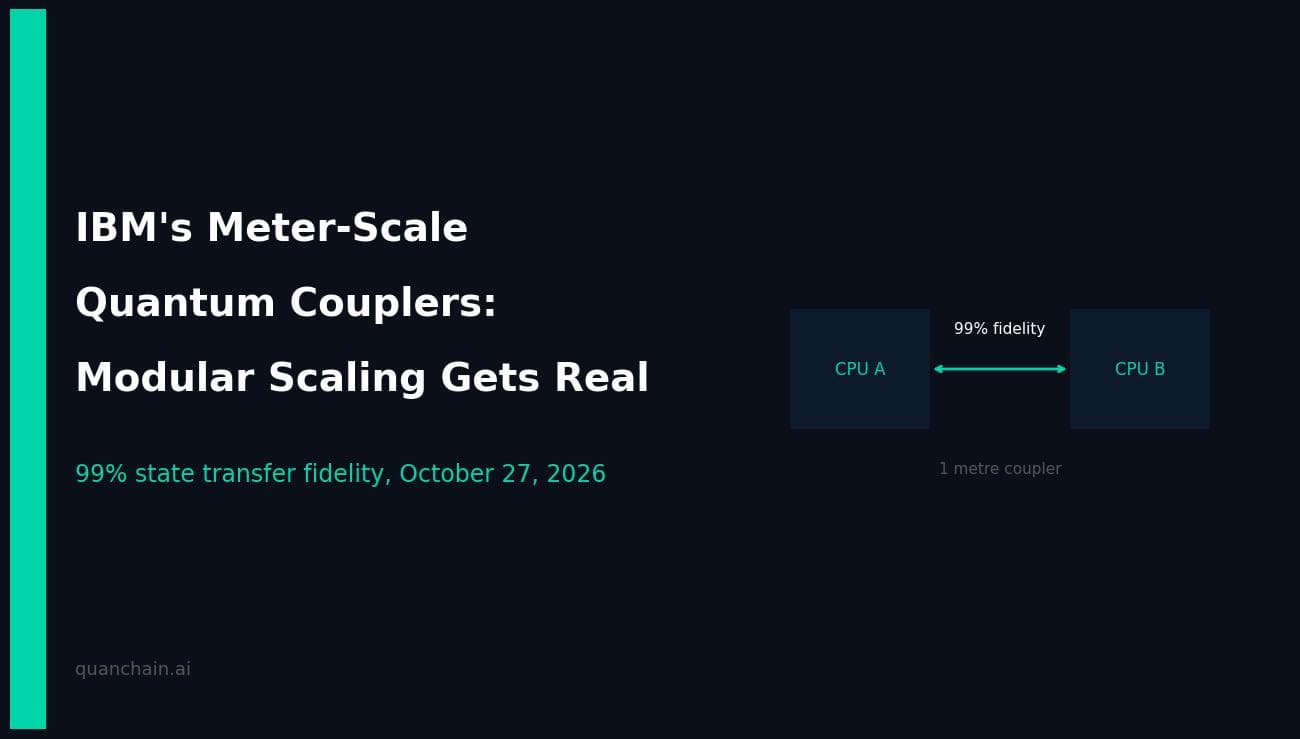
October 2026 changed the framing. Three separate quantum hardware architectures each reached significant milestones in the same month: IBM demonstrated modular superconducting coupling at 99% fidelity, PsiQuantum showed an 8x8 silicon photonics optical switch manufactured on a CMOS platform, and QuEra's neutral-atom approach continued its progress on logical qubit demonstrations.
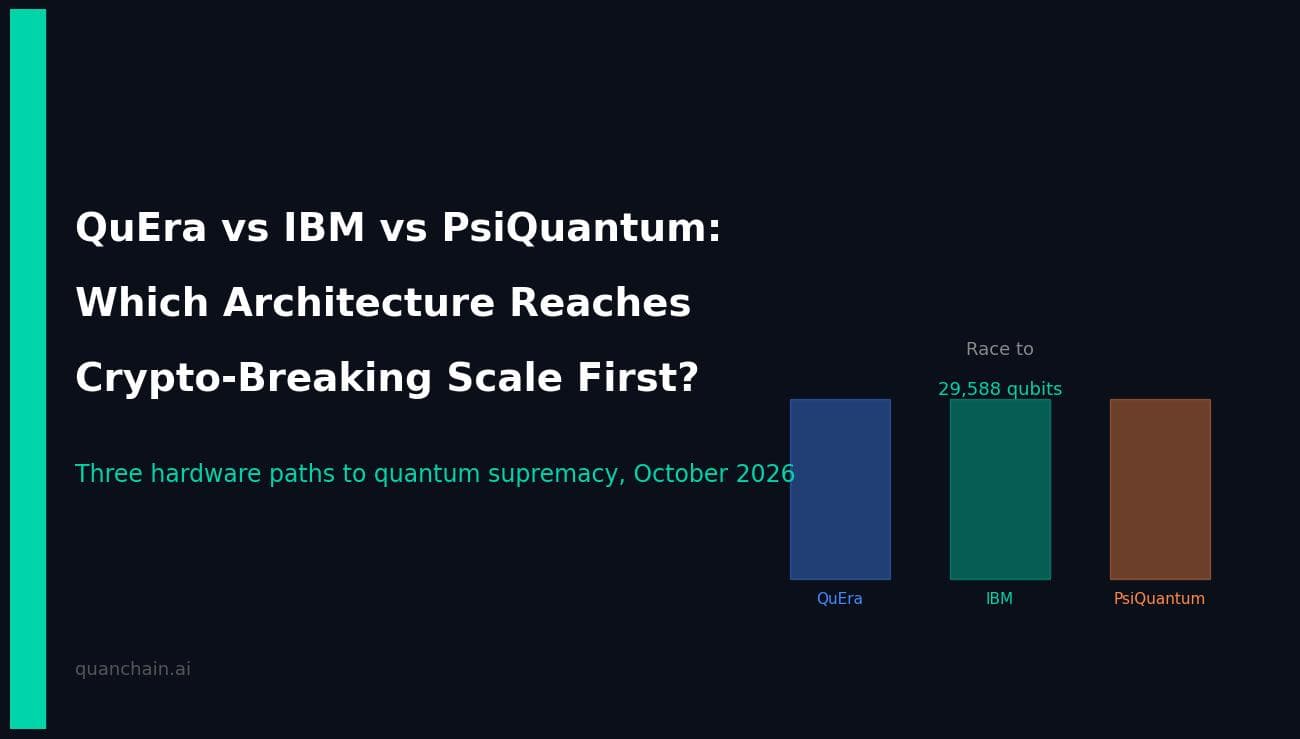
When multiple independent approaches are making parallel progress, the probability that at least one reaches the required threshold within a given time window is substantially higher than the probability for any single approach. The blockchain security calculus must account for all credible paths to the ~29,588 physical qubit threshold identified in Alice & Bob's October 2026 analysis.
Architecture 1: Superconducting Qubits (IBM, Google)
Superconducting qubits encode quantum information in the quantized energy levels of an artificial atom made from Josephson junctions and superconducting resonators. They operate at millikelvin temperatures inside dilution refrigerators.
Strengths
- Gate speed: Superconducting gates operate in nanoseconds, faster than neutral-atom or photonic operations. Faster gates mean more operations per unit time, which affects attack speed for cryptographic computations.
- Mature fabrication: IBM and Google have been building superconducting quantum processors for over a decade. The fabrication processes are well-understood and yield has improved substantially.
- Established error correction: Most published results on surface code error correction use superconducting qubits. Error correction thresholds and overhead factors are well-characterized.
Challenges
- Cryogenic scaling: All qubits must operate at millikelvin temperatures. Scaling to 29,588 qubits requires either enormous cryostats or modular inter-chip connections. IBM's October 2026 modular coupler demonstration at 99% fidelity addresses this, but 99.9% is needed for fault-tolerant modular connections without excessive overhead.
- Qubit connectivity: Superconducting qubits typically have limited native connectivity — each qubit can interact with only a few nearest neighbors on a 2D grid. Long-range operations require SWAP gates, adding overhead.
Path to 29,588 Qubits
IBM's roadmap: achieve inter-chip fidelity of 99.9% on modular couplers, demonstrate multi-hop modular connections, scale to 25+ processors of 1,200 qubits each. Estimated timeline for fault-tolerant logical qubit operation: 2028-2030.
Architecture 2: Neutral Atoms (QuEra, Pasqal)
Neutral-atom quantum computers trap individual atoms in arrays of focused laser beams (optical tweezers). Quantum operations are performed by briefly exciting atoms into Rydberg states, where they interact strongly with neighboring atoms.
Strengths
- All-to-all connectivity: Atoms can be physically repositioned in the trap array, enabling arbitrary qubit connectivity rather than nearest-neighbor-only. This reduces SWAP gate overhead for algorithms requiring long-range interactions.
- Identical qubits: All neutral atoms of the same species are identical, eliminating the unit-to-unit variation that plagues superconducting fabrication and affects yield.
- Room-temperature loading: Atom loading and array preparation can be performed at room temperature. Only the trapping region requires vacuum and precise laser systems.
- Logical qubit demonstrations: QuEra demonstrated logical qubit operations below the physical qubit error rate in 2023, one of the first demonstrations of practical quantum error correction advantage.
Challenges
- Gate speed: Rydberg-mediated two-qubit gates operate in microseconds, roughly 1,000x slower than superconducting gates. For algorithms requiring millions of gate operations, this extends computation time significantly.
- Qubit count: QuEra's current systems operate with 256 physical qubits. Scaling to tens of thousands requires trapping and controlling proportionally more atoms with the same precision. Laser power and beam-shaping requirements scale unfavorably.
Path to 29,588 Qubits
Neutral-atom scaling requires larger trap arrays and proportionally more control lasers. The connectivity advantage reduces SWAP overhead, potentially offsetting the gate speed disadvantage for some algorithms. Estimated timeline: competitive scaling by 2030-2033, but gate speed disadvantage may mean longer computation times even at the required qubit count.
Architecture 3: Silicon Photonics (PsiQuantum, Quandela)
Photonic quantum computers encode information in photon states. Operations are performed through linear optical elements (beam splitters, phase shifters, waveguides) and single-photon detectors. PsiQuantum's CMOS-compatible platform allows these components to be manufactured at semiconductor fab scale.
Strengths
- Manufacturing scalability: CMOS-compatible fabrication can produce billions of components per wafer. The path to millions of photonic qubits does not require custom fab infrastructure — it uses existing semiconductor manufacturing.
- Room-temperature operation: Most photonic routing components operate at room temperature. Only single-photon detectors require cryogenic cooling (typically 4K, far less demanding than millikelvin superconducting systems).
- Low-loss fiber networking: Photonic qubits travel naturally through optical fiber, enabling inter-chip and inter-module connections without cryogenic couplers.
Challenges
- Photon loss: Every optical component absorbs or scatters some photons. Unlike classical optics, quantum states cannot be amplified. Maintaining low loss over large circuit depths requires very high-quality components.
- Single-photon sources: Deterministic single-photon sources — which emit exactly one photon on demand with high efficiency and indistinguishability — remain a manufacturing challenge.
- Non-deterministic gates: Linear optical quantum computing gates succeed probabilistically. Managing the heralding and feedforward requirements at large scales adds complexity.
Path to 29,588 Qubits
PsiQuantum skips intermediate noisy quantum hardware entirely, targeting fault-tolerant operation from the first system. The October 2026 8x8 switch demonstrates key component progress. Estimated timeline: fault-tolerant demonstration by 2031-2034, with rapid manufacturing scaling once the technology is validated.
Comparative Timeline Estimates
| Architecture | Current Scale | Key Remaining Milestone | Estimated Fault-Tolerant Timeline |
|---|---|---|---|
| Superconducting (IBM) | 1,121 qubits (single chip) | 99.9% inter-chip fidelity for modular connections | 2028-2030 |
| Neutral atoms (QuEra) | 256 qubits | Scale trap array to 10,000+ atoms with equivalent fidelity | 2030-2033 |
| Silicon photonics (PsiQuantum) | Component demonstrations | Integrated single-photon sources at yield on CMOS | 2031-2034 |
The Conclusion for Blockchain Security
The answer to "which architecture reaches 29,588 qubits first" is less important than the observation that multiple credible approaches are converging on the same threshold from different directions.
If blockchain security depends on all quantum hardware approaches failing to reach the required scale within a given window, the probability of that outcome is the product of the individual failure probabilities — which is substantially lower than any single failure probability.
The October 2026 milestones — IBM's modular couplers, PsiQuantum's CMOS photonics switch, ongoing neutral-atom progress — collectively indicate that the quantum threat to secp256k1-based blockchain cryptography is not a single-point risk but a broad-front convergence. Effective mitigation requires action that is independent of which architecture "wins."
Post-quantum migration to ML-DSA or SLH-DSA is the only response that remains effective regardless of which quantum hardware approach reaches cryptographic relevance first.