The Modular Scaling Problem
One of the most persistent challenges in building large-scale quantum computers is physical size. Superconducting qubits must operate at temperatures near absolute zero, inside dilution refrigerators that cost millions of dollars and occupy several cubic meters. There is a practical limit to how many qubits can fit on a single chip while maintaining the fidelity and connectivity needed for useful computation.
IBM's current largest monolithic processor contains 1,121 qubits on a single chip. To reach the fault-tolerant scale needed for cryptographically relevant computations — tens of thousands to millions of physical qubits — the industry needs a way to connect multiple chips or processors without introducing unacceptable error rates at the inter-chip boundary. This is the modular quantum computing problem.
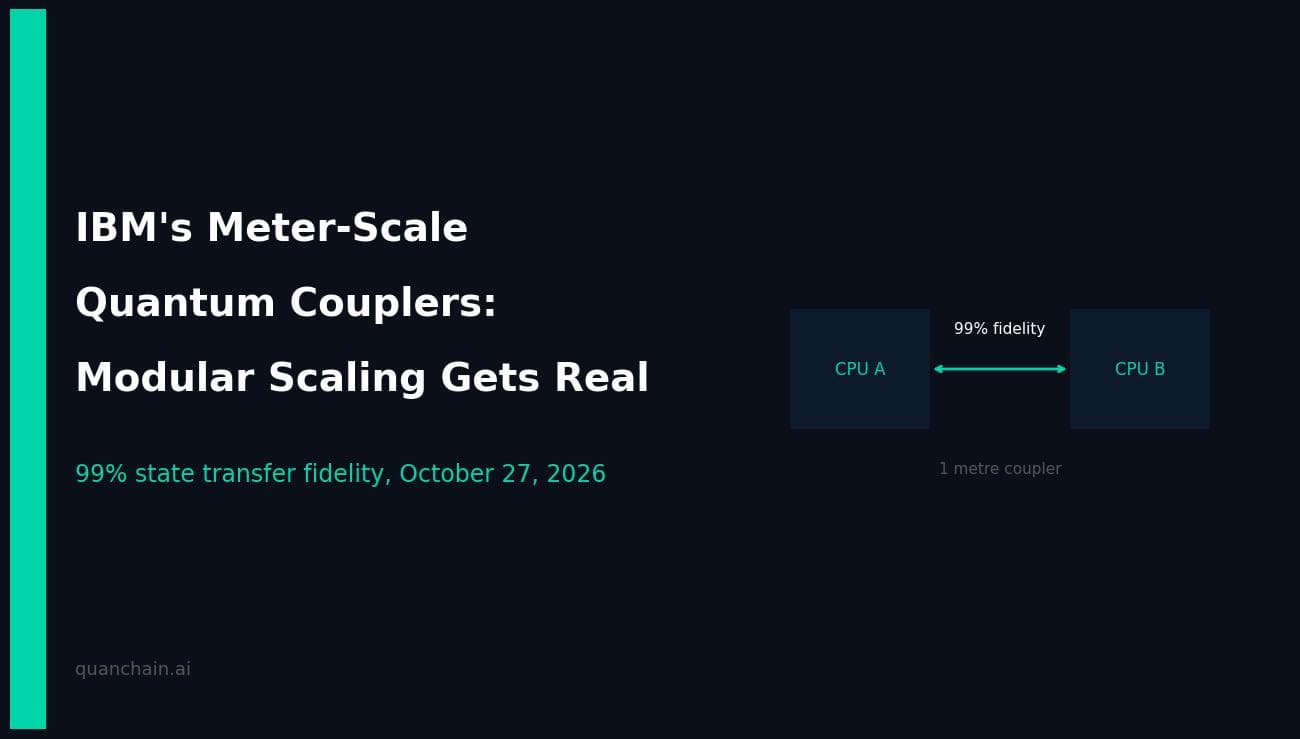
On October 27, 2026, IBM announced a significant advance in this direction: meter-scale superconducting couplers that link two 120-qubit processors with 99% state transfer fidelity. The demonstration does not yet represent a commercial product, but it establishes that the fundamental physics of inter-chip quantum state transfer at this distance is tractable.
What 99% Fidelity Means
State transfer fidelity measures how accurately a quantum state is transmitted from one location to another. A fidelity of 99% means that, on any given transfer, there is a 1% probability of an error being introduced.
That sounds good. In classical computing, a 1% error rate would be catastrophic. But in quantum computing, errors are managed by error correction codes that can tolerate a certain physical error rate. The threshold error rate for surface code quantum error correction is approximately 1% — meaning a 99% fidelity operation is right at the edge of the correctable regime.
This is why the difference between 99% and 99.9% fidelity matters so much. At 99% fidelity, error correction is possible but requires significant overhead: many physical qubits per logical qubit, driving up the resource requirements. At 99.9% fidelity, the error correction overhead drops substantially, making the same logical qubit computation far less expensive in physical resources.
IBM's October 2026 demonstration achieved 99% over a one-meter distance. The next engineering target is 99.9%, which would make modular connections practical for fault-tolerant computation without the overhead penalty.
Why Meter Scale Is the Relevant Distance
One meter is not an arbitrary benchmark. It is approximately the distance between two rack-mounted dilution refrigerators in a standard data center layout. Demonstrating state transfer at this distance confirms that the coupler technology can operate in a real infrastructure setting rather than just in a laboratory with idealized distances.
The coupling mechanism IBM used is a microwave-frequency coaxial cable cooled to millikelvin temperatures, running between two cryostats. The signal travels through a quantum-limited amplifier at each end that preserves the quantum state while boosting the signal amplitude. The engineering challenge is maintaining the temperature gradient along the length of the cable without introducing thermal noise that corrupts the quantum state.
Implications for Scaling Timelines
Modular quantum computing changes the scaling math. Instead of needing to fit all required qubits on a single chip — a fabrication challenge that grows exponentially with qubit count — engineers can distribute qubits across multiple processors and connect them via couplers. This is analogous to how classical computing moved from single-chip processors to multi-chip modules and eventually to distributed server farms.
The practical implication for cryptographically relevant computation is that the path to 29,588 fault-tolerant physical qubits no longer requires a single chip that large. It could be achieved with, for example, 25 processors of 1,200 qubits each, connected via modular couplers. At IBM's current fabrication capacity, building 25 such processors is an engineering management problem, not a fundamental physics obstacle.
The timeline to reach this configuration depends on improving inter-chip fidelity from 99% to 99.9% and demonstrating that multi-hop connections — linking more than two processors — maintain acceptable error rates across the network.
Qubit Counts Needed for Different Cryptographic Targets
| Cryptographic Target | Logical Qubits Required | Physical Qubits (at 99.9% fidelity) | Status |
|---|---|---|---|
| RSA-2048 factoring | ~4,000 | ~4 million (aggressive distillation) | Far future |
| Bitcoin secp256k1 (no time limit) | ~2,330 | ~29,588 (modern surface code) | 5-10 year horizon |
| AES-128 (Grover) | ~2,953 logical | ~millions | Far future |
| Lattice-based PQC (ML-KEM, ML-DSA) | Not known to be vulnerable | Not applicable | Quantum-safe |
The table illustrates that secp256k1 — the signature algorithm used by Bitcoin, Ethereum, and most blockchain networks — is the most accessible target for a near-term quantum attack. It requires far fewer resources than RSA-2048 or breaking symmetric encryption.
What IBM's Demonstration Means for the Competitive Landscape
IBM is not the only organization pursuing modular quantum computing. Google's Quantum AI team has published approaches to quantum networking between processors. PsiQuantum is building photonic quantum computers that use standard fiber optics for inter-chip connections, which scales differently but addresses the same fundamental problem. IonQ and Quantinuum are pursuing trapped-ion approaches with different connectivity models.
The October 2026 IBM demonstration is significant because it applies to the superconducting qubit architecture that currently holds the largest installed base of quantum processors. Demonstrating modular scaling in superconducting hardware clears the path for incremental improvements on top of an already-mature fabrication and control electronics stack.
Near-Term Expectations
IBM's roadmap, published in 2023 and updated in 2025, targets fully error-corrected logical qubits suitable for utility-scale computation by 2029. The October 2026 modular coupler demonstration is consistent with that roadmap. Achieving 99.9% inter-chip fidelity is the next milestone; IBM's engineering teams have indicated they expect to demonstrate this within 18 months.
For blockchain operators and cryptographers, the relevant monitoring indicators are: physical qubit count across an integrated modular system, inter-chip fidelity approaching 99.9%, and the first demonstration of a logical qubit maintained across a modular connection. When those three conditions are met simultaneously, the timeline to cryptographically relevant computation compresses significantly.
The migration window to post-quantum cryptography is open now. The question is how long it stays open.