Cardano's Cryptographic Baseline: ed25519
Cardano uses ed25519 for wallet key pairs and transaction signing. Ed25519 is the Edwards-curve Digital Signature Algorithm on Curve25519. It is a well-designed elliptic curve scheme with strong classical security properties. It is not quantum-resistant.
Shor's algorithm, running on a cryptographically relevant quantum computer, breaks elliptic curve discrete logarithm problems. That includes ed25519. Any Cardano wallet that has signed a transaction has its public key on-chain, and that public key is sufficient for a quantum attacker to derive the private key and forge signatures. The exposure is identical in structure to Ethereum's quantum exposure and Solana's. The Ethereum post-quantum roadmap illustrates how account abstraction and EIP-driven governance are shaping that chain's approach.
What distinguishes Cardano is not its current cryptographic state. It is the research orientation of Input Output Global (IOG), the organization that developed Cardano, and the structural properties of the eUTXO model that may affect migration paths.
Does the eUTXO Model Help with Quantum Migration?
Cardano uses an extended UTXO model (eUTXO) rather than an account-based model. In the UTXO model, coins are not stored in accounts with persistent balances. Instead, they exist as unspent transaction outputs, each locked to a specific spending condition. To spend a UTXO, you provide a witness (typically a signature) that satisfies the locking condition.
This has a structural implication for quantum migration. In an account-based system, every account has a persistent public key on-chain. In a UTXO system, a public key only becomes visible when the UTXO is spent. UTXOs that have never been spent have not revealed their public keys on-chain, assuming the address uses a hash of the public key rather than the raw public key.
Cardano's standard Shelley-era addresses use a hash of the public key as the payment credential. This means unspent UTXOs in standard Shelley addresses have not exposed their signing keys. The quantum attack surface is smaller than in an account model for coins that have never moved.
The practical caveat is significant. Any UTXO that has been spent has revealed its public key in the spending transaction. And in practice, active Cardano wallets regularly spend and receive UTXOs. Most economically active ADA is in wallets whose public keys are on-chain. The structural advantage of eUTXO matters more for long-dormant holdings than for active users. The comparison with Bitcoin's UTXO quantum exposure is instructive here.
What Has IOG Published on Post-Quantum Cryptography?
IOG has published academic research on post-quantum cryptography in the context of blockchain systems. Their research output includes papers examining post-quantum signature schemes compatible with UTXO-based blockchains, and analysis of how hash-based signatures like XMSS and SPHINCS+ would interact with Cardano's transaction model.
IOG's research approach is more formal than most blockchain organizations. They publish peer-reviewed academic work, engage with cryptography conferences, and maintain research agendas that address long-term protocol evolution. This is a genuine differentiator from chains where protocol development is primarily driven by engineering decisions without formal cryptographic analysis.
However, there is a gap between published research and deployed protocol changes. As of 2026, no post-quantum signature scheme has been implemented in Cardano's mainnet. IOG's research activity demonstrates awareness and preparation, but does not constitute a deployed solution. Investors should distinguish between research maturity and production readiness. Chains like Algorand, which ran a dedicated Falconnet testnet, demonstrate what more advanced research-to-deployment progress looks like.
What Would a Post-Quantum Migration Require for Plutus Contracts?
Cardano's smart contract platform is Plutus. Plutus scripts execute on-chain and can include cryptographic verification operations. A post-quantum migration would need to address not just wallet signatures but also any Plutus contracts that perform signature verification internally.
DeFi protocols, multi-signature schemes, and other Plutus applications that verify ed25519 signatures as part of their logic would need to be updated or redeployed. This is not trivial. Plutus scripts are compiled to Untyped Plutus Core (UPLC), which runs in a resource-metered execution environment. Post-quantum signature verification is more computationally expensive than ed25519 verification.
The Plutus execution budget system assigns execution units to CPU and memory operations. Adding post-quantum signature verification to on-chain scripts would require those operations to be priced within the execution budget framework. This needs protocol-level changes to the execution cost model, not just a library update.
The number of Plutus contracts that would require migration is smaller than Ethereum's smart contract ecosystem, but the complexity of coordinating those migrations across the DeFi ecosystem is real. Protocol upgrades on Cardano go through a governance process, which adds coordination overhead but also provides a structured path for community buy-in — a challenge shared by Polkadot, whose OpenGov system would need to coordinate a migration across its entire parachain ecosystem.
How Does Cardano's Governance Process Affect a Post-Quantum Upgrade?
Cardano uses a formal on-chain governance system. Protocol parameter changes and major upgrades go through a proposal process involving stake pool operators, delegated representatives (DReps), and the constitutional committee. This process is more structured than informal developer consensus but also slower than unilateral development team decisions.
A post-quantum upgrade would qualify as a hard fork. Hard forks on Cardano follow the hard fork combinator mechanism, which allows multiple protocol versions to coexist briefly during transitions. This is a technically sophisticated approach to protocol upgrades, and it provides a cleaner migration path than networks that require simultaneous cutover.
The Cardano Improvement Proposal (CIP) process is where post-quantum migration would begin. No CIP addressing a post-quantum signature transition had reached formal proposal status as of June 2026. The groundwork exists in IOG's research, but the governance and engineering work to translate that research into a deployable upgrade has not been completed.
Where Does Cardano Stand Relative to Other Chains?
Cardano's post-quantum posture is more research-mature than most blockchains. The combination of IOG's academic publishing record, the eUTXO model's structural properties, and the hard fork combinator's upgrade mechanism gives Cardano a more developed foundation for eventual post-quantum migration than chains that have done no formal analysis.
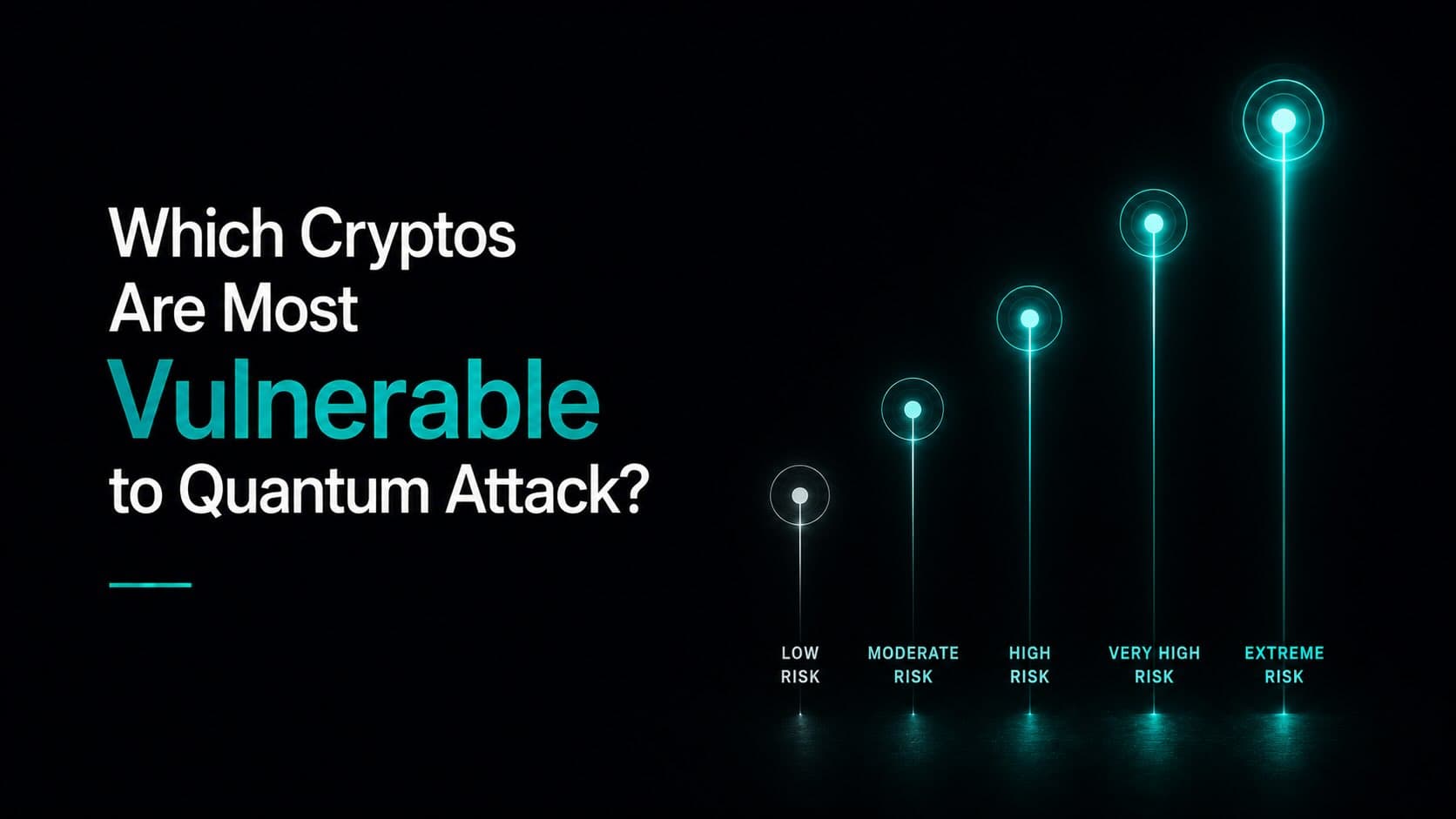
That said, research maturity is not the same as quantum resistance. Cardano's mainnet uses ed25519 today. Its users face the same fundamental exposure as users of any other elliptic curve blockchain. The cryptocurrency quantum vulnerability ranking covers how different chains compare on this dimension.
For investors evaluating Cardano's long-term security profile, the honest assessment is this: Cardano is more prepared than most chains to eventually make the transition, but it has not made it yet. The gap between research and deployment is where risk lives. A blockchain that builds post-quantum cryptography into its protocol from the start eliminates that gap entirely. The top quantum-resistant blockchains in 2026 covers the options that have closed that gap.