Dr. Sarah Chen
What Is Post-Quantum Cryptography?
Post-quantum cryptography (PQC) refers to cryptographic algorithms designed to resist attacks from both classical and quantum computers. The term is slightly misleading — these algorithms run on classical hardware today. What makes them "post-quantum" is that the mathematical problems underlying them are believed to remain computationally intractable even for a fault-tolerant quantum computer running Shor's or Grover's algorithms.
The development of PQC standards has been an international effort spanning nearly a decade. In 2016, the U.S. National Institute of Standards and Technology (NIST) launched a formal competition to evaluate and standardize post-quantum algorithms. In 2024, NIST published its final standards: CRYSTALS-Kyber (for key encapsulation), CRYSTALS-Dilithium (for digital signatures), SPHINCS+ (for hash-based signatures), and FALCON (for compact lattice-based signatures).
These standards represent the current scientific consensus on which mathematical structures are most likely to withstand quantum attacks. Understanding why requires a look at the underlying families.
How Lattice-Based Cryptography Resists Quantum Attacks
Lattice-based cryptography is built on problems related to geometric structures called lattices — grids of points in high-dimensional space. The two core hard problems are:
- Learning With Errors (LWE): Given a system of noisy linear equations over a lattice, recover the hidden secret. The "noise" is what makes this hard — without it, solving the system is straightforward linear algebra.
- Shortest Vector Problem (SVP): Find the shortest nonzero vector in a lattice. This sounds geometric, but in hundreds of dimensions, it becomes computationally overwhelming.
Both LWE and SVP have resisted attack by the best classical and quantum algorithms known. CRYSTALS-Dilithium, the NIST-standardized signature scheme, is built on Module-LWE, a structured variant that enables compact key and signature sizes without sacrificing security.
CRYSTALS-Dilithium
Dilithium produces digital signatures analogous to ECDSA — a signer uses a private key to sign a message, and anyone with the corresponding public key can verify the signature. The difference is in the underlying math: where ECDSA derives its security from the elliptic-curve discrete logarithm (broken by Shor's algorithm), Dilithium derives its security from Module-LWE (no known quantum speedup).
Dilithium comes in three security levels: Dilithium-2 (NIST Level 2, comparable to AES-128), Dilithium-3 (NIST Level 3), and Dilithium-5 (NIST Level 5, comparable to AES-256). QuanChain implements Dilithium-5 as its primary signature scheme — the highest available security level.
CRYSTALS-Kyber
Kyber is a key encapsulation mechanism (KEM), not a signature scheme. It allows two parties to establish a shared secret over an insecure channel — the post-quantum replacement for Diffie-Hellman key exchange. Kyber is used extensively in QuanChain's channel-to-channel communication and cross-chain coordination protocols.
Hash-Based Cryptography: SPHINCS+ and Quantum Resistance
Hash-based signature schemes derive their security from the collision resistance and pre-image resistance of cryptographic hash functions — properties that are weakened but not broken by Grover's algorithm. This makes hash-based schemes among the most conservative and well-understood approaches to post-quantum signatures.
SPHINCS+
SPHINCS+ (pronounced "sphincs plus") is the NIST-standardized hash-based signature scheme. Unlike lattice-based schemes, SPHINCS+ makes no assumptions about algebraic structure — its security reduces entirely to the properties of an underlying hash function. This makes it exceptionally robust: even if lattice-based hardness assumptions turn out to be weaker than expected, SPHINCS+ remains secure as long as SHA-256 or SHAKE-256 remain collision-resistant.
The tradeoff is signature size. SPHINCS+ signatures are significantly larger than Dilithium signatures — on the order of 8–50 KB depending on the parameter set, compared to roughly 2.5 KB for Dilithium-5. This makes SPHINCS+ less suitable as a universal replacement for ECDSA but extremely valuable as a redundant layer.
SPHINCS+-256f is the fast variant at the 256-bit security level. "Fast" here means optimized for signing speed at the cost of slightly larger signatures — the right tradeoff for a blockchain where transaction throughput matters.
Code-Based Cryptography: McEliece and Error-Correcting Codes
Code-based cryptography predates lattice-based approaches by decades. The McEliece cryptosystem, proposed in 1978, bases its security on the difficulty of decoding a general linear error-correcting code — a problem that has resisted attack for nearly fifty years, including from quantum algorithms.
The main drawback of code-based schemes is key size: McEliece public keys can be several megabytes, making them impractical for many blockchain applications. More recent variants like Classic McEliece have improved this somewhat, and NIST included Classic McEliece as an additional KEM standard specifically for use cases that prioritize long-term conservatism over bandwidth efficiency.
QuanChain incorporates code-based primitives in its Quantum Oracle's threat modeling layer, using them as a verification cross-check rather than a primary scheme.
Why One Algorithm Is Never Enough: Composite PQC
A reasonable question: if Dilithium-5 is NIST-standardized and considered secure, why not just use it and stop there?
The answer is cryptographic conservatism. Lattice-based schemes are relatively young. ECDSA had decades of cryptanalysis before anyone trusted it with real money; Dilithium has had years. The mathematical problems underlying lattice schemes have not been broken, but they also haven't accumulated the same depth of scrutiny that RSA or elliptic-curve cryptography has.
Composite PQC — combining multiple independent schemes — provides defense in depth: the system remains secure even if one of the underlying algorithms turns out to have an unexpected weakness.
QuanChain implements a composite signature scheme combining Dilithium-5 and SPHINCS+-256f. A transaction is only considered valid if both signatures verify. Because the two schemes rely on entirely different mathematical assumptions (Module-LWE for Dilithium, hash function security for SPHINCS+), breaking the composite requires simultaneously breaking both — a dramatically higher bar than breaking either alone.
Using composite post-quantum cryptography is like requiring two independent locks on the same door — not because either lock is known to be weak, but because the cost of simultaneously picking two unrelated mechanisms is exponentially higher than picking one.
How QuanChain's Implementation Works in Practice
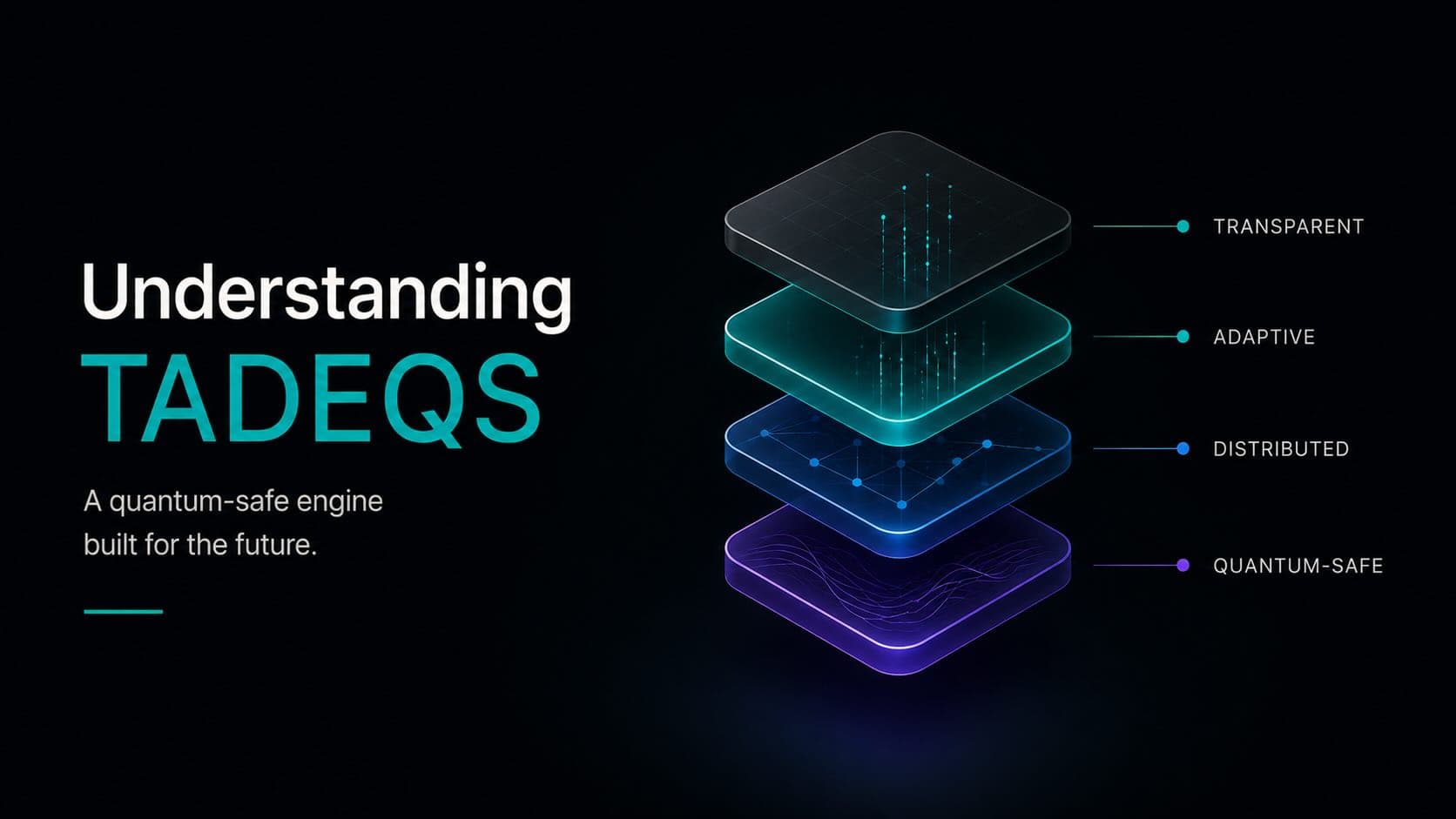
Every QuanChain transaction carries two signatures: a Dilithium-5 signature and a SPHINCS+-256f signature. Both are verified by every node before a transaction is included in a block. This happens transparently — users and developers interacting with QuanChain through the standard SDK do not need to manage two key pairs. The TADEQS wallet layer handles key generation, rotation, and dual-signature construction automatically.
The Quantum Oracle also continuously evaluates whether the current parameter sets remain appropriate given observed quantum hardware capabilities. If monitored threat signals indicate that Dilithium-5's effective security margin is narrowing, the network can migrate to stronger parameters through the three-tier trigger system — again, without user intervention.
This combination — composite PQC at the signature layer, dynamic adaptation at the network layer — reflects QuanChain's core design philosophy: cryptographic security should be both technically sound and operationally resilient. A cryptographic scheme that requires a hard fork to upgrade is only as good as its governance process. QuanChain's is built to stay ahead of the curve automatically.
Related Post-Quantum Cryptography Resources
For developers who want to go deeper:
- NIST's official PQC standards documentation (FIPS 203, 204, 205) is available at nist.gov
- The CRYSTALS team publishes Dilithium and Kyber specifications and reference implementations at pq-crystals.org
- The SPHINCS+ team's reference implementation and parameter selection guide is available at sphincs.org
- QuanChain's technical whitepaper covers the composite implementation in detail