Dr. Sarah Chen
The U.S. Government Just Set a Hard Quantum Deadline
For years, the quantum threat to Bitcoin and cryptocurrency was treated as a distant, theoretical concern. Prominent voices dismissed it as imaginary. Others compared it to Y2K. Most agreed it was a problem for future generations of developers to solve.
Two executive orders signed by President Donald Trump changed that framing in a single news cycle. The orders, titled "Securing the Nation Against Advanced Cryptographic Attacks" and "Ushering in the Next Frontier of Quantum Innovation," did not just acknowledge the quantum threat: they attached government deadlines to it. All U.S. federal systems must complete their migration to post-quantum cryptography by 2031. The National Institute of Standards and Technology (NIST) is directed to complete a pilot migration by the end of 2027. Federal contractors may be required to comply by the end of 2030.
Those dates land in the same window that multiple independent research teams, including IBM, Google, and NIST itself, have identified as the period during which fault-tolerant quantum computers capable of breaking elliptic-curve cryptography could plausibly exist. The U.S. government has, in effect, told the world when it believes it needs to be ready, and Bitcoin developers have been handed the same window whether they wanted it or not.
What the Two Executive Orders Actually Say
The first order, "Ushering in the Next Frontier of Quantum Innovation," is an acceleration directive. It establishes a national initiative to develop advanced quantum computing capabilities and sets a target of having a quantum computer capable of performing significant scientific and commercial calculations within five years. The order positions quantum computing as a strategic technology priority, comparable in framing to the space race or the Manhattan Project, and directs federal agencies to coordinate funding, research, and infrastructure investment accordingly.
The second order, "Securing the Nation Against Advanced Cryptographic Attacks," is a defence directive. It mandates that all U.S. government computer systems transition to post-quantum encryption standards, with a hard deadline of 2031 for full migration. The order directs NIST to lead the technical process, establishes a 2027 target for completing a pilot migration across critical government infrastructure, and extends the compliance requirement to federal contractors by the end of 2030.
Read together, the two orders create a striking juxtaposition. The same administration is simultaneously racing to build the technology that could theoretically break current encryption and issuing binding instructions to prepare all federal systems for that eventuality. That is not a contradiction in strategy: it is an acknowledgement that quantum computing is an adversarial race, and that the United States intends to both win the offensive capability and harden its defensive posture before adversaries with their own quantum programs can exploit the transition period.
Why Crypto Twitter Reacted
The immediate reaction across cryptocurrency social media centred on one number: approximately 7 million Bitcoin. Weeks before Trump's executive orders were signed, Coinbase published a quantum threat assessment that identified roughly 6.9 million BTC held in addresses whose public keys are already exposed on-chain. These are addresses that have been spent from at least once, meaning the public key that corresponds to the private key controlling those funds has been permanently broadcast to the entire Bitcoin network.
A quantum computer running Shor's algorithm does not need to intercept a transaction to attack those funds. The public keys are already available in the historical blockchain data. Any sufficiently capable quantum computer could, in principle, derive the private keys from those public keys and drain the corresponding wallets without the owners broadcasting a single transaction. The Coinbase report made this exposure concrete by quantifying it in Bitcoin terms. Trump's executive orders gave it a government-endorsed timeline.
The specific concern that spread across Crypto Twitter was the convergence of these two data points: the U.S. government has decided that quantum computers capable of cryptographically significant computation could arrive within the 2027 to 2031 window, and 7 million BTC worth of public keys have already been harvested and are sitting in public view on the blockchain, waiting for hardware that can exploit them.
The Saylor, BlackRock, and Y2K Comparisons
Commentary visible in the immediate social media reaction illustrated the spectrum of views the executive orders provoked. Michael Saylor, the co-founder of MicroStrategy and one of Bitcoin's most prominent advocates, had previously described the quantum threat as imaginary. BlackRock's position, reflected in its risk disclosures, is that the threat is real but solvable. Pio Vincenzo, a vocal Bitcoin commentator, drew the Y2K comparison: a threat that generated enormous concern and preparation effort but ultimately did not materialise in the catastrophic form that had been feared.
Each of these positions contains a defensible kernel. Saylor's dismissal was calibrated to the timeline expectations of a few years ago, when cryptographically relevant quantum hardware appeared to be decades away. BlackRock's view acknowledges the technical solvability of the problem without committing to a specific timeline. The Y2K comparison is instructive precisely because Y2K was averted, not because the risk was fictional: it was addressed through years of costly preparation, and the preparation worked. The risk existed, the deadline was real, and the outcome was benign because people took it seriously in advance.
What the executive orders do to all three of these framings is add a government timeline that makes the "distant future" framing untenable. The U.S. federal government, with access to classified intelligence about adversarial quantum programs, has decided that 2031 is the right deadline for completing its own migration. That decision is not made casually. It reflects an assessment of when quantum hardware is likely to reach cryptographically relevant capability, adjusted for the lead time required to migrate complex government systems.
The 2026 quantum computing timeline compression article documents how rapidly expert timelines have shortened: estimates that once placed cryptographically relevant quantum computers 15 to 20 years away have been revised multiple times toward nearer-term targets as hardware progress has accelerated faster than expected.
The NIST Migration Timeline in Detail
NIST published its first three post-quantum cryptographic standards in August 2024: FIPS 203 (ML-KEM, for key encapsulation), FIPS 204 (ML-DSA, for digital signatures), and FIPS 205 (SLH-DSA, for hash-based signatures). These standards, the result of an eight-year international competition and analysis process, represent the algorithms that the U.S. government has certified as ready for post-quantum deployment.
Under the executive order, NIST is directed to complete a pilot migration of critical government infrastructure to these standards by the end of 2027. "Pilot migration" means that a defined set of high-priority government systems, not the full government estate, will have completed their transition. The full federal migration deadline is 2031. Federal contractors, who operate systems that connect to and support federal networks, face a 2030 compliance deadline under the proposed contractor requirements.
The 2027 to 2031 span is significant because it represents the same period during which, according to the government's own assessment, the most capable adversarial quantum programs are expected to reach cryptographically relevant thresholds. The migration deadline is not a comfortable buffer after the threat arrives. It is calibrated to be completed before the threat window opens, with the pilot migration at 2027 acting as the leading edge of a rolling deployment. For the detailed specification of what NIST standardised and why, see NIST post-quantum cryptography standards 2024.
What This Means for Bitcoin's 2031 Window
Bitcoin developers did not ask for a government-imposed deadline, but they now have one by proxy. If the U.S. federal government, operating with classified intelligence about adversarial quantum programs, believes that 2031 is the right date for completing critical cryptographic infrastructure migration, then the assumption that Bitcoin has more time than that is difficult to justify.
Bitcoin's post-quantum response, centred on BIP-360 and the proposed Pay-to-Quantum-Resistant-Hash (P2QRH) output type, has not yet reached the activation stage. The proposal is algorithm-agnostic: it lists CRYSTALS-Dilithium, FALCON, and SPHINCS+ as candidate schemes but has not selected one. Activation would require broad developer and miner consensus. After activation, the migration of 7 million BTC worth of exposed addresses would require active participation from holders, many of whom are unreachable or do not interact with their wallets regularly.
The full analysis of what BIP-360 proposes, what it leaves unresolved, and what the migration challenge looks like at scale is in Bitcoin's post-quantum response plan. The bottom line is that Bitcoin's governance process, which operates by rough consensus and moves slowly by design, would need to accelerate substantially to activate and deploy a post-quantum upgrade within the same window the federal government is using for its own systems.
The throughput implications of post-quantum signatures add a further constraint. Whatever signature scheme BIP-360 adopts, per-transaction data will increase by at least 10 times relative to ECDSA. Without a parallel block size change, Bitcoin's throughput would fall below 1 TPS after the migration. The Dilithium signature size and throughput analysis documents the block capacity arithmetic for each NIST-standardised option.
The Harvest Now, Decrypt Later Dimension
One aspect of the quantum threat that receives less attention in social media discussions is the harvest now, decrypt later (HNDL) strategy. Well-resourced adversaries, including nation-state intelligence programs, do not need to wait until quantum hardware exists to begin the attack. They can collect and store the public keys from Bitcoin's blockchain today, and they can decrypt them when hardware becomes available.
The blockchain is public. Every exposed public key is available to anyone. The harvest phase of a HNDL attack on Bitcoin has, effectively, already happened: the blockchain is the harvest database. The question is not whether the 6.9 million BTC worth of exposed public keys will be collected but when the hardware to exploit them will exist.
Trump's executive orders encode the U.S. government's best estimate of when that hardware will arrive. The government's internal planning assumption, reflected in the 2031 hard deadline, is that it needs its own systems migrated before that window. Funds sitting in exposed Bitcoin addresses do not benefit from the federal migration. They require their own owners to act. The guide to assessing your personal Bitcoin quantum risk covers the criteria for determining whether and when to migrate to a quantum-protected wallet.
The Irony at the Heart of the Two Executive Orders
The social media commentary noted a structural irony in the two orders that is worth examining directly. The Trump administration has positioned itself as a champion of Bitcoin, with public statements in favour of making the United States a Bitcoin superpower and policy moves designed to position American financial infrastructure around Bitcoin and digital assets.
The same administration has simultaneously issued an executive order to accelerate the development of quantum computing to the point where a cryptographically capable machine could exist within five years, and a second order acknowledging that such a machine would represent a threat to current encryption standards severe enough to require a 2031 federal deadline for protection.
This is not necessarily a contradiction. A government that takes Bitcoin seriously as a strategic asset has strong reasons to want both capabilities: it wants to ensure that adversaries cannot use quantum computers to attack Bitcoin holdings before the U.S. government's own cryptographic systems are protected, and it wants American institutions to be at the frontier of quantum hardware rather than playing catch-up. But the net effect, as several commentators observed, is that the administration has simultaneously bet on Bitcoin's long-term value and validated the technical basis for the threat that could compromise Bitcoin's security model if the network does not upgrade in time.
What a Quantum-Native Blockchain Offers That Bitcoin Cannot Retrofit
The federal migration analogy is instructive for understanding the structural difference between retrofitting post-quantum cryptography and building for it from the start. The federal government is treating the 2027 to 2031 migration as a major multi-year infrastructure programme, involving thousands of systems, multiple agencies, and billions of dollars of effort. The challenge is manageable, according to the government's own assessment, but it requires starting immediately and executing systematically over several years.
Bitcoin faces a harder version of the same problem. Federal systems have administrators who can be directed to upgrade. Bitcoin has no administrators. Its upgrade process depends on the voluntary consensus of a globally distributed set of developers, miners, and node operators, many of whom have divergent economic interests and governance philosophies. The history of Bitcoin's block size debates and SegWit activation illustrates how contested that process can become even when the technical case is strong.
A blockchain designed from its first block to use post-quantum cryptography does not face this migration challenge. QuanChain's TADEQS architecture uses Dilithium-5 (ML-DSA-87, NIST Level 5) for all signatures, and its SpendAndRotate mechanism ensures that no public key is ever persistently stored on-chain. There is no pool of exposed public keys to harvest. There is no migration to complete before 2031 because the chain was never built on cryptography that requires migration.
The definition of a quantum-resistant blockchain and the specific properties it requires provide a framework for evaluating any chain's quantum posture against the timeline the federal government has now made official.
2031 Is Now the Reference Date
Before these executive orders, the quantum threat to Bitcoin existed in a soft timeline: it was a problem that would need to be solved at some point, when hardware advanced sufficiently, with a vague sense that there was enough time to figure it out. The executive orders replaced that soft timeline with a hard one. The U.S. government, with access to intelligence about adversarial quantum programs that the public does not have, has decided that 2031 is when its own defences need to be complete.
That does not mean Bitcoin will be attacked in 2031. It means that the government's best internal estimate places the threat window in that zone. Preparations should be measured against that estimate, not against earlier, more comfortable projections. Bitcoin developers, holders, and infrastructure providers now have a reference date provided by the most well-resourced intelligence apparatus in the world.
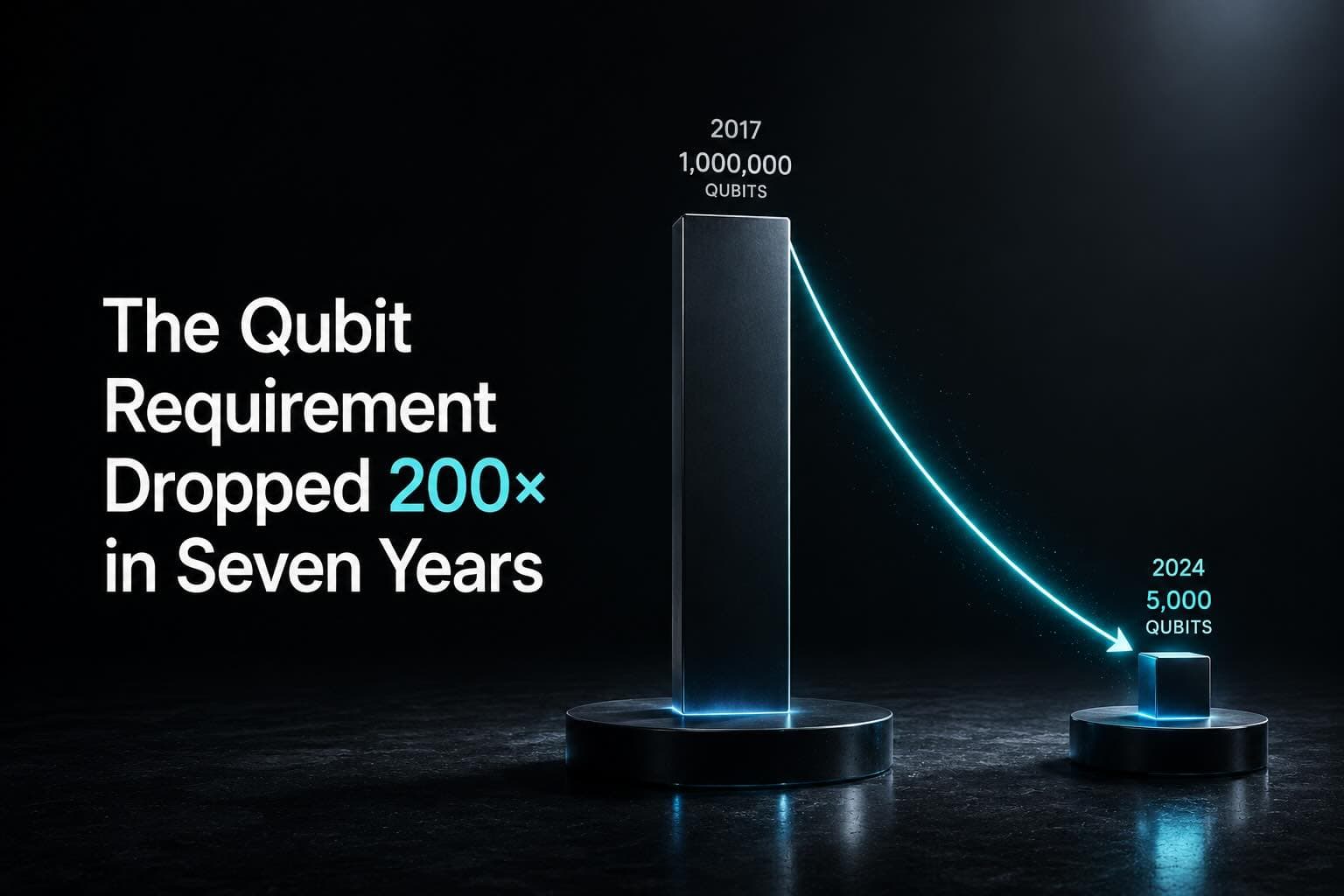
The clock, as AirdropAlert noted in its reaction to the orders, got louder. Whether Bitcoin's governance process can move fast enough to respond within the same window the federal government is using for its own systems is the most consequential open question in cryptocurrency security today. For the detailed hardware requirements analysis, see how many qubits it takes to break Bitcoin and the full context of what Q-Day looks like for Bitcoin.
When the U.S. government sets a 2031 deadline for migrating its own cryptographic infrastructure, and simultaneously funds an effort to build quantum computers within five years, the resulting message for any party relying on elliptic-curve cryptography is unambiguous: the migration window is open, and it is not indefinite.