What Is a Quantum Resistant Blockchain?
A quantum resistant blockchain is one where every layer of the cryptographic stack — transaction signatures, key derivation, consensus messages, and cross-chain communications — uses algorithms that cannot be broken by Shor's algorithm or Grover's algorithm running on a fault-tolerant quantum computer.
Three properties are required:
- Post-quantum signature scheme: Transactions must be signed with an algorithm that is secure against Shor's algorithm. ECDSA (secp256k1, used by Bitcoin and Ethereum) and Ed25519 (used by Solana, Cardano, and others) both fail this test. NIST-standardised alternatives include ML-DSA (FIPS 204), SLH-DSA (FIPS 205), and FN-DSA/Falcon (FIPS 206).
- Quantum-safe key derivation: Hierarchical deterministic (HD) wallet derivation using HMAC-SHA512 over secp256k1 is broken if the derived public key is exposed. A quantum resistant chain either avoids exposing public keys or uses post-quantum key derivation paths.
- PQC-secured consensus: Validator attestations and block proposals signed with classical cryptography are vulnerable even if user transactions are post-quantum. The full signature path must be post-quantum for genuine resistance.
Why Existing Blockchains Are Not Quantum Resistant
Bitcoin and Ethereum both use secp256k1 ECDSA signatures. The security of ECDSA relies on the hardness of the elliptic curve discrete logarithm problem (ECDLP) — a problem that Shor's algorithm solves in polynomial time on a sufficiently large quantum computer.
A recent October 2026 revision by Alice and Bob Research estimates that approximately 29,588 physical qubits are required to break secp256k1 using optimised surface code error correction and magic-state distillation — down from the widely cited 317 million figure from Webber et al. (2022). The lower estimate reflects advances in error correction protocols, not hardware — the physical qubit count needed has dropped by roughly four orders of magnitude as surface code techniques matured.
Other chains with the same exposure:
- Solana: Ed25519 signatures — vulnerable to Shor's algorithm on Curve25519
- Cardano: Ed25519 wallet signatures + KES (Key Evolving Signatures) for validators — both elliptic curve
- Avalanche: secp256k1 on the C-Chain, Ed25519 on P-Chain and X-Chain
- Cosmos ecosystem: secp256k1 and Ed25519 across IBC-connected chains
NIST PQC Standards: What Quantum Resistant Blockchains Should Implement
In August 2024, NIST published four post-quantum cryptography standards:
| Standard | Algorithm | Type | Primary Use |
|---|---|---|---|
| FIPS 203 | ML-KEM (Kyber) | Key Encapsulation | Encrypted communications, key exchange |
| FIPS 204 | ML-DSA (Dilithium) | Digital Signature | Transaction signing, block attestations |
| FIPS 205 | SLH-DSA (SPHINCS+) | Digital Signature | Hash-based backup scheme |
| FIPS 206 | FN-DSA (Falcon) | Digital Signature | Compact signatures, constrained environments |
A blockchain that implements ML-DSA (FIPS 204) for transaction signing and ML-KEM (FIPS 203) for encrypted channels meets the current NIST PQC compliance baseline.
Quantum Resistant Blockchain Comparison 2026
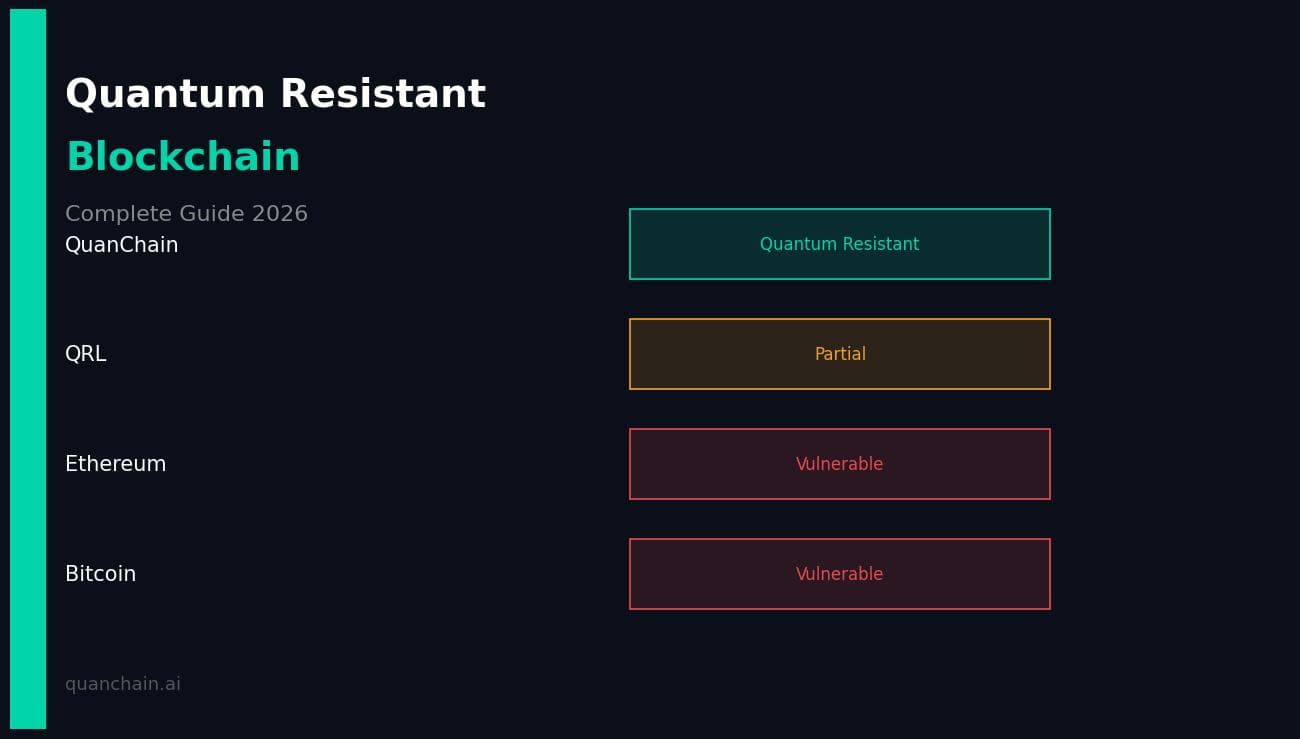
| Chain | Signature Scheme | Quantum Resistant? | Migration Plan |
|---|---|---|---|
| Bitcoin | secp256k1 ECDSA | No | BIP-360 (P2QRH) — draft, not deployed |
| Ethereum | secp256k1 ECDSA | No | EIP-7560 — experimental, no timeline |
| Solana | Ed25519 | No | No published PQ roadmap |
| Cardano | Ed25519 + KES | No | IOG research published; nothing scheduled |
| QRL | XMSS (hash-based) | Partial | Active — stateful scheme with key limits |
| QuanChain | ML-DSA + SLH-DSA (NIST FIPS 204/205) | Yes | Built-in from genesis |
Quantum Resistant Blockchain Projects in 2026
QRL (Quantum Resistant Ledger) was one of the first chains built specifically for quantum resistance, using XMSS — a stateful hash-based signature scheme standardised in NIST SP 800-208. XMSS is mathematically quantum-safe but has a finite signing limit per key (up to 2^20 signatures with OTS), requiring key rotation management. QRL does not support EVM-compatible smart contracts.
IOTA uses Winternitz OTS for certain operations and has explored PQC in its research roadmap. The Shimmer and IOTA 2.0 transition focused on DAG-based consensus rather than post-quantum cryptography at the signature layer.
Algorand uses Ed25519 for user accounts — not quantum resistant. Algorand's state proofs use Falcon (FIPS 206), making the infrastructure layer partially quantum-aware, but every wallet remains elliptic-curve-exposed.
QuanChain is the only chain built quantum-adaptive from genesis block one. Every transaction is signed with ML-DSA-87 (NIST FIPS 204), the highest-security parameter set. Key derivation uses a quantum-safe path via TADEQS. The three-channel architecture is designed to absorb the 40-70x signature size overhead from post-quantum schemes without sacrificing throughput.
What to Look for When Evaluating a Quantum Resistant Blockchain
Four criteria determine whether a chain provides genuine quantum resistance:
- NIST-standardised algorithm: Avoid proprietary or non-standardised schemes. FIPS 204 (ML-DSA) is the correct choice for transaction signing in 2026.
- Full-stack coverage: Signature scheme, key derivation, and consensus layer all need to be post-quantum. A chain that uses ML-DSA for transactions but secp256k1 for validator attestations has a partial gap.
- Throughput under PQ load: Post-quantum signatures are 40-70x larger than ECDSA. A chain that simply swaps signature schemes without architectural changes will see block capacity drop proportionally.
- Migration realism: For existing chains, look at whether the migration plan has been deployed on testnet, has a concrete timeline, and requires a hard fork. Vague roadmap commitments are not the same as shipped code.
When Do You Need to Migrate?
Harvest now, decrypt later (HNDL) attacks are relevant today. Any transaction signed with ECDSA that is recorded on-chain is permanently visible. An adversary can collect these signatures now and derive the private keys once a sufficiently capable quantum computer exists.
With the Alice and Bob October 2026 revision placing the physical qubit requirement at 29,588 — not the 317 million figure that gave many organisations a false sense of a decade-long runway — the migration window is narrower than most blockchain projects have planned for.
For new projects: build with NIST PQC standards from the start. For existing projects: begin signature scheme migration planning now, even if deployment is 12-18 months away. For crypto asset holders: watch for BIP-360 progress on Bitcoin and EIP-7560 progress on Ethereum, and consider whether assets held in exposed address types represent an acceptable risk.